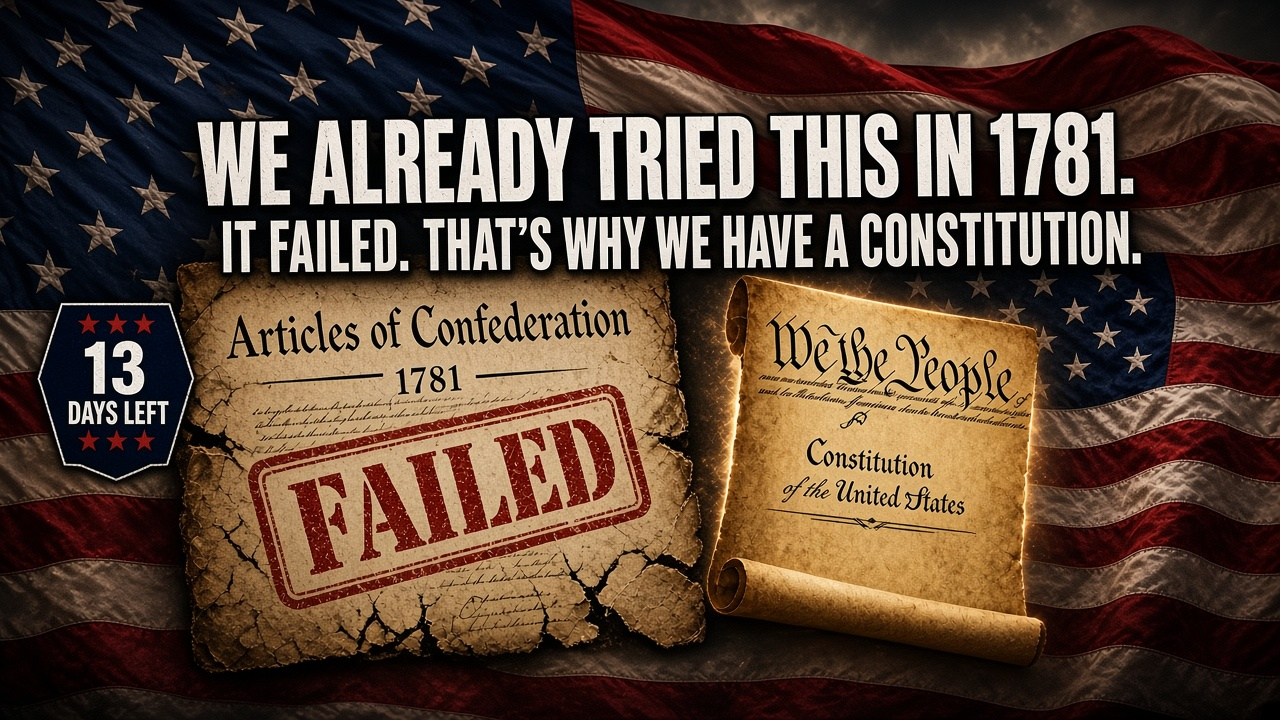
13 Days Left — The Briefing: We Already Tried This in 1781‼️
I took an oath in the United States Air Force to support and defend the Constitution. I’ve hauled freight across this country, and I rode with the People’s Convoy from California to Washington, D.C. One thing I learned on every one of those roads: you don’t get to swap out the rig halfway through the run because you don’t like the dispatcher. You stop at the scale, you follow the rules, and you get where you’re going.
This week, recordings surfaced that suggest some people think otherwise. With 13 days left until Tuesday, November 3, 2026 (Congressional Research Service), I’m going to walk you through what was reported, what’s been said about it, and why the idea at the center of it has already been tried in America — and failed.
No scare stories. Just what’s on the record, and what history teaches.
What Surfaced This Week
On October 19, the researcher who posts as DataRepublican (“DataRepublican (small r)”) published a thread titled “THE DEMOCRACY FILES, PART 2: WHEN AND HOW TO DECLARE THE FEDERAL GOVERNMENT ILLEGITIMATE.” (DataRepublican on X) The thread has been viewed more than two million times.
According to DataRepublican:
- The source. “The videos all come from Renew to Thrive (R2T) group and associates. Danielle Reiff and Paul Zeitz play key roles within R2T.” (DataRepublican)
- The umbrella. R2T “sits inside a much, much larger umbrella called United Democracy Alliance (UDA),” which DataRepublican describes as “an extremely hush-hush control plane of leaders from major ‘blocking’ NGOs such as 50501 and Indivisible.” (DataRepublican)
- R2T’s job. DataRepublican writes that R2T’s role “is concerned with ‘the day after tomorrow’ – in other words, their function is to conceive what a rewritten American government will look like.” (DataRepublican)
- Who’s credited. Per the thread, Erica Chenoweth “is credited with conceiving UDA in the first place under the Horizons ‘Big Tent’ initiative,” and National Security Leaders for America (NSL4A), “a group of 1,600 ex-military, intelligence, and diplomatic officials” led by “Rear Admiral Michael E. Smith (Ret),” “is credited for operationalizing UDA.” (DataRepublican)
- The “redlines.” DataRepublican says the group “outlined a sequence of ‘redlines’ in which case the federal government should be declared illegitimate,” and that “Invoking the Insurrection Act against ‘peaceful’ protesters is one of the most discussed redlines.” (DataRepublican)
- The governors. “The audio shows they shopped this idea around governors,” DataRepublican writes, adding her view that governors “do not have to explicitly sign on” — “All they have to do is refuse troops in their state.” (DataRepublican)
Those are DataRepublican’s characterizations of the material. The words that matter most come from the recording itself.
What the Recording Says
Senator Mike Lee of Utah quote-posted the thread and pulled out two lines from the audio (Sen. Mike Lee on X):
“If the federal government’s deemed to be illegitimate … then the governors become the leading governing authority under the current republic framework of our Constitution.”
“I really want to emphasize this is not a concept for a secession. No one is talking about leaving the United States.”
Senator Lee’s response:
“Of course they’re not ‘talking about leaving the United States’; they’re talking about a planned transfer of governing authority outside the constitutional process—replacing the authority of the federal government with governors and outside networks.”
And — this part matters — he added:
“I hope this turns out to be a deep fake or a bad practical joke—because if it’s real, it’s unbelievably frightening.”
He closed with: “Either way, it’s a good reminder to vote carefully in November.” (Sen. Mike Lee)
Glenn Beck highlighted another clip. According to Beck, Danielle Reiff, a former USAID diplomat, “spent 20 years managing ‘democratic transitions’ in places like South Sudan,” and is now in strategy sessions from the DSA’s “Democratic Constitution Forum,” “openly talking about using a ‘crisis of legitimacy’ during the midterms as a ‘window of opportunity’ to force a complete transformation of our system.” (Glenn Beck on X) Beck frames it as a “color revolution strategy” that USAID “spent decades perfecting” overseas, now “bringing the same playbook home.” That is Beck’s interpretation.
As reported by The Post Millennial, Reiff said on an August 13, 2026 call that “we end up in a very acute legitimacy crisis sometime in the next few months or the next few years, where literally our federal government becomes illegitimate,” and that “we can take that breakdown moment and leverage it for a big structural reform, you know, refounding moment.” (The Post Millennial)
Straight Talk: What We Know and What We Don’t
Patriot Roster calls balls and strikes, so here it is plain:
- The recordings have not been independently authenticated in anything I’ve read. Senator Lee himself said he hopes it’s a deep fake or a joke.
- The speakers deny secession. On tape, they say “No one is talking about leaving the United States.” I’m taking them at their word on that.
- Not everyone reads it the same way. One outlet that reviewed the material, The Last Daily, said it “exposes a real ecosystem of election-crisis planning” but “does not yet prove the clandestine command structure” DataRepublican alleges. (The Last Daily)
- The people and groups named have every right to answer for themselves. If they respond, I’ll report it.
But here’s what doesn’t need a fact-check: the idea itself. Declare the national government “illegitimate” by a private list of redlines, and let governors step in as “the leading governing authority.” Whatever anyone intends, that is a transfer of authority outside the process the Constitution lays out. And Americans have seen a government built on strong states and a weak center before.
We lived under it for eight years. It nearly broke the country.
We Already Tried This: The Articles of Confederation
What follows is my analysis — the people on these calls have not said they want the Articles back. But when you take authority away from the national government and hand it to the states, you are walking back down a road the Founders already traveled.
The Articles of Confederation took effect in 1781 and governed the United States until the Constitution replaced them in 1789. Article II of the Articles said it straight: “Each state retains its sovereignty, freedom, and independence.” (Articles of Confederation, Avalon Project) Here’s how that worked out:
- No power to tax. Congress could only ask the states for money. The states often didn’t pay.
- Couldn’t pay the war debt. The country that just beat the British Empire couldn’t pay the soldiers and creditors who made it happen.
- No executive. There was no president to enforce the laws Congress passed.
- No national court system to settle disputes under national law.
- Couldn’t raise an army on its own. It could only request troops from the states.
- Trade wars between the states. With no national power over commerce, states threw up barriers against each other’s goods.
- Nearly impossible to fix. Any amendment had to be “confirmed by the legislatures of every State” — all thirteen. (Avalon Project)
Alexander Hamilton didn’t mince words in Federalist No. 15: “We may indeed with propriety be said to have reached almost the last stage of national humiliation.” The “great and radical vice,” he wrote, was “the principle of LEGISLATION for STATES or GOVERNMENTS” — a national government that could pass resolutions but had “no authority to raise either” men or money from the citizens themselves. (Federalist No. 15, Avalon Project)
Shays’ Rebellion: The Wake-Up Call
Then came Shays’ Rebellion in 1786 and 1787. Farmers in western Massachusetts, crushed by debt and taxes, closed courts and, in January 1787, moved on the federal armory at Springfield. The national government couldn’t put it down. Under the Articles, it had no money and no army of its own; a Massachusetts militia, partly paid for by private businessmen, had to do it. (National Constitution Center)
That shook Washington, Madison and Hamilton. In September 1786, delegates from just five states met at the Annapolis Convention on trade problems. Too few showed up to act, so they called for a broader meeting in Philadelphia. (Constitution Annotated, Congress.gov)
That meeting became the Constitutional Convention of 1787. It met from May to September 17, 1787, and instead of patching the Articles, the delegates wrote a whole new framework: the Constitution of the United States. (Congress.gov)
The Constitution exists because “the states will handle it” was tried, and it failed.
What the Constitution Actually Says
The Founders didn’t leave this to guesswork. Three provisions speak right to it:
- The Supremacy Clause (Article VI). The Constitution and federal laws made under it “shall be the supreme Law of the Land; and the Judges in every State shall be bound thereby, any Thing in the Constitution or Laws of any State to the Contrary notwithstanding.” (Constitution Annotated, Art. VI)
- The Oath (also Article VI). State legislators “and all executive and judicial Officers… of the several States, shall be bound by Oath or Affirmation, to support this Constitution.” Every governor in America has taken that oath. (Art. VI)
- The Guarantee Clause (Article IV, Section 4). “The United States shall guarantee to every State in this Union a Republican Form of Government.” (Constitution Annotated, Art. IV, §4)
Nowhere does the Constitution allow a coalition of nonprofits, retired officials or anybody else to declare the national government “illegitimate” and hand the keys to the governors!
How You Change a Government in America
If you want a different government, the Constitution gives you exactly two roads — and both run through the people:
- Elections. Every two years, all 435 House seats. Every six years, each Senate seat. Every four years, the presidency. That’s the steering wheel.
- Article V. Want to change the Constitution itself? Two-thirds of both houses of Congress, or a convention called by two-thirds of the states, can propose an amendment. Then three-fourths of the states have to ratify it. (Constitution Annotated, Art. V) It’s hard on purpose.
Disagree with a president? Vote. Disagree with a law? Go to court, go to Congress, or amend the Constitution. That’s not weakness. That’s the system working. A “refounding moment” built on a crisis skips the people entirely.
Your 13-Day Action Plan
1. Vote — and vote early if you can. Check your registration at vote.org and find your state’s early voting and mail-ballot deadlines at vote.org’s early voting page or your Secretary of State’s site (Can I Vote / NASS). If you vote by mail, send it back now.
2. Know where your state officials stand. Your governor, attorney general and secretary of state each swore an oath to the Constitution. Ask them, in writing or at a town hall, a simple question: Will you uphold the Supremacy Clause and the results of lawful elections, win or lose? Find out where the candidates on your ballot stand, too. Thirty-six governors’ seats are on the ballot this year. (NBC News)
3. Watch the polls the right way. Contact your county election office, your county party or a campaign about becoming a certified poll watcher or election worker. Get trained, follow your state’s rules to the letter, and report problems through official channels. Honest elections need honest eyes — not confrontation.
4. Bring three. Three neighbors, three church friends, three grandkids. Make sure they’re registered and have a plan.
5. Share this briefing. Most Americans have never heard of Shays’ Rebellion. Send this to someone who loves this country and ought to know why the Constitution was written in the first place.
Bottom Line
The people on these recordings say they aren’t talking about secession, and Senator Lee hopes the whole thing is a fake. Fair enough. But the idea on the table — declare Washington illegitimate and let the governors take the lead — is a road America has already driven. It ended at Shays’ Rebellion and an empty treasury. The Founders fixed it in Philadelphia in 1787.
We don’t need a “refounding.” We need citizens who keep the one we’ve got.
Thirteen days. Vote carefully, vote all the way down the ballot, and bring three.
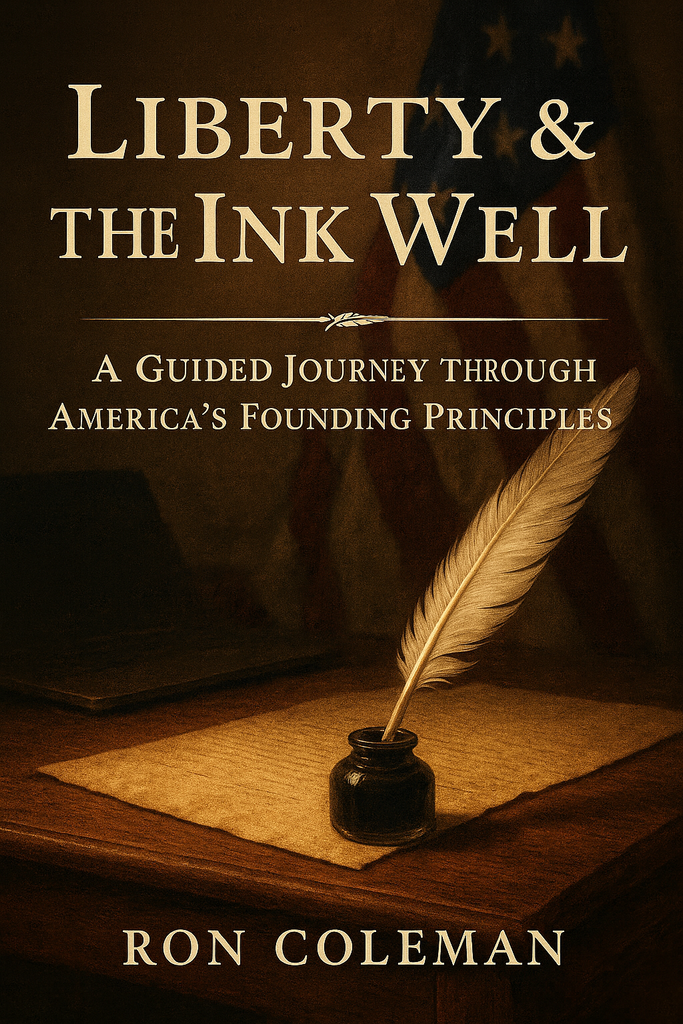
Want the Whole Story? Read Liberty & the Ink Well
I wrote Liberty & the Ink Well: A Guided Journey Through America’s Founding Principles because too many Americans were never taught why the Articles of Confederation failed. It was a “firm league of friendship” with no power to tax, no executive, and soldiers paid with promises.
Chapter 2 walks you through Valley Forge and Shays’ Rebellion, the alarm bell that sent the delegates to Philadelphia.
Chapter 9 shows how the Supremacy Clause and the oath of office fixed what the Articles broke, because, as I put it in the book, “nations collapse when laws become suggestions and oaths become ornaments.”
Every chapter has stories, trivia, and an Ink Well journal prompt, so it works for your family, classroom, or church group.
Grab your copy here: Liberty & the Ink Well
Wake up. Show up. Stand up.
— Ron “Grey Wolf” Coleman, Founder, Patriot Roster
________________________________________
Sources: Quotes from the recordings are as published by DataRepublican, Sen. Mike Lee, Glenn Beck and The Post Millennial; the recordings have not been independently authenticated. Founding-era texts are from Yale’s Avalon Project and the Constitution Annotated. The Articles-of-Confederation comparison is Patriot Roster’s analysis, not a goal stated by the speakers.